ASTM F1918 Compliance and Daily Operations Checklist
Commercial indoor playgrounds and family entertainment centers (FECs) generate revenue through repeat visits, dwell time, and word-of-mouth trust. None of that holds up without a structured maintenance system. A facility that treats cleaning and inspection as an afterthought is exposed on two fronts at once: liability risk from undetected structural or hygiene failures, and operational downtime when equipment is pulled from service for unplanned repairs.
Maintenance, cleaning, and safety compliance are three distinct but interlocking functions. Maintenance addresses structural and mechanical integrity. Cleaning addresses surface hygiene and pathogen control. Compliance ties both back to a documented standard that can be referenced during insurance review, incident investigation, or franchise audit.
For soft contained play equipment specifically, that baseline standard is ASTM F1918, the Standard Safety Performance Specification for Soft Contained Play Equipment. It is the reference point operators, designers, and manufacturers use to evaluate whether a play structure was designed, built, and is being maintained to reduce the risk of life-threatening or debilitating injury.
ASTM F1918 is published and maintained by ASTM International, under the jurisdiction of Committee F15 on Consumer Products and Subcommittee F15.36 on Soft-Contained Play Systems. The standard was originally approved in 1998 and has since been revised, most recently as F1918-21.
Its stated scope covers soft contained play equipment intended for users from 2-year-old to 12-year-old. Public playground equipment, amusement rides, fitness equipment, and water attractions fall outside its scope; those are governed by separate standards, including ASTM F1487 for public playground equipment.
The standard's structure moves through several compliance areas that operators and turnkey manufacturers need to understand independently of one another:
It is worth stating plainly: ASTM F1918 is a design, manufacturing, and installation safety specification — it is not a cleaning or sanitation manual. The standard does include a Maintenance section addressing inspection intervals and component replacement, but it does not prescribe disinfectant chemistry or cleaning frequency. Hygiene protocols for indoor playgrounds are typically built by combining ASTM F1918's structural maintenance requirements with public health cleaning guidance, such as that published by the CDC for community and early-childhood settings.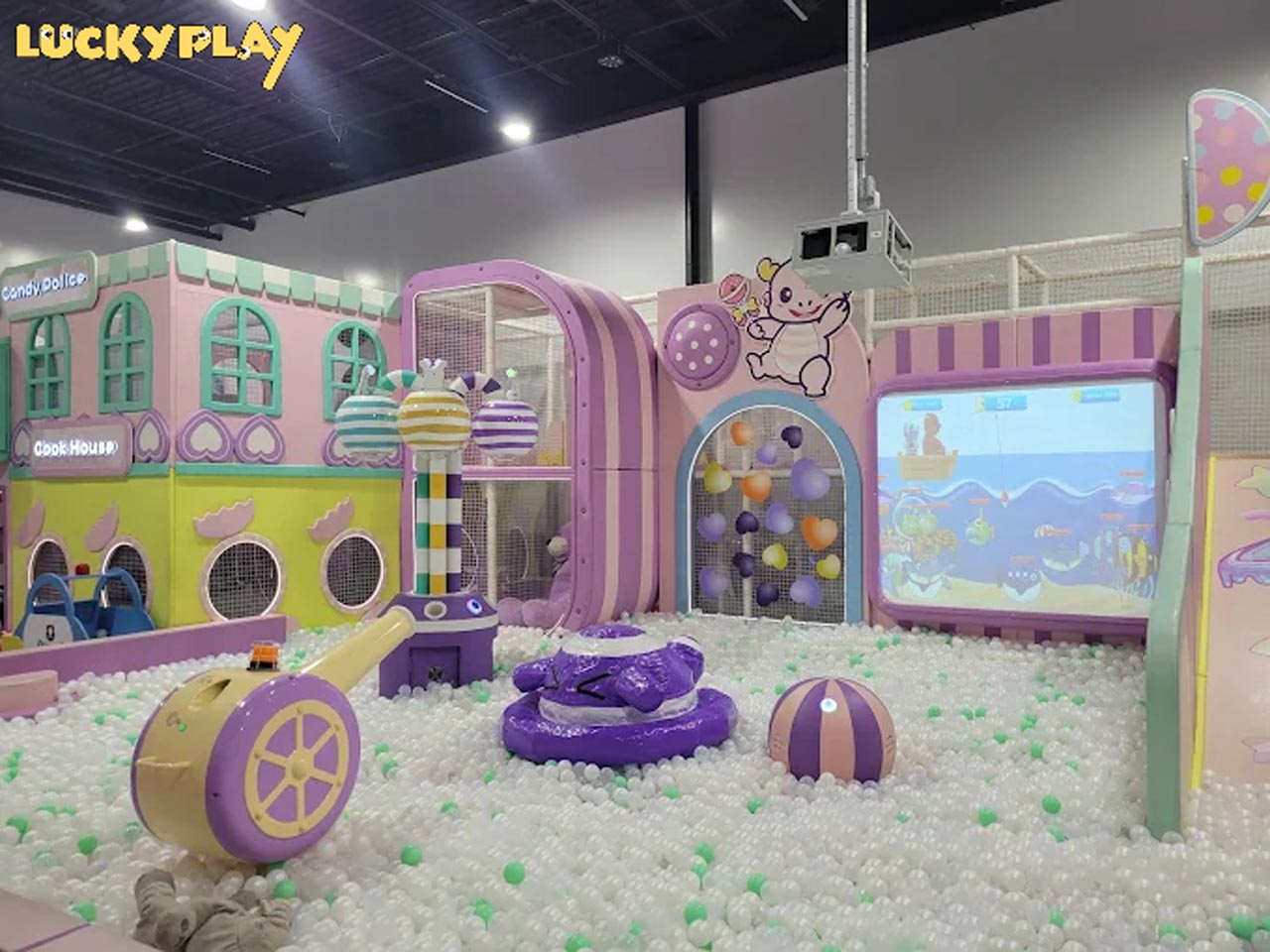
Daily tasks are the first line of defense against both injury risk and hygiene complaints. They are short, repeatable, and should be logged by name, time, and signature for liability documentation.
Before opening and at intervals through the operating day, staff should walk the structure looking for torn vinyl or foam covering, exposed internal padding, loose stitching on netting, and any sharp edges created by wear.
Connector pins, quick-links, and netting attachment points should be checked by hand for play or looseness. Any netting with frayed rope or stretched mesh should be flagged for replacement, not patched.
Handrails, climbing grips, slide entry points, and tunnel openings qualify as high-touch surfaces under CDC facility cleaning guidance, which recommends cleaning high-touch surfaces regularly and disinfecting when visibly soiled or after illness exposure. These surfaces should be wiped down at set intervals throughout the operating day, not only at open and close.
Foam mats and impact-attenuating flooring should be checked for compression, separation at seams, and surface tearing. Compressed or displaced matting directly reduces the impact attenuation performance the structure was designed around.
Ball pits require a visible-debris check at minimum daily: food residue, liquid spills, and any balls that are cracked or punctured should be pulled immediately, since damaged balls trap moisture and organic material.
Weekly deep cleaning extends beyond high-touch wipe-downs to full-surface cleaning of slides, tunnels, climbing nets, and tube structures, removing accumulated grime that daily spot cleaning does not reach.
All bolted and pinned connections across the play structure should be checked with a torque wrench or manual force against the manufacturer's specification, since repeated dynamic loading from active play gradually loosens fasteners.
A complete weekly sanitization removes all balls, washes the pit base and side panels, and either washes or replaces balls according to the manufacturer's care instructions before the pit is restocked.
Indoor playgrounds operate in enclosed, high-occupancy environments, making HVAC filter condition and airflow rate a recurring weekly check rather than an annual one.
A maintenance log — paper or digital — should record what was inspected, what was found, what was corrected, and who performed the check. This log is the operational evidence referenced during insurance claims, incident review, or franchise compliance audits.
Welds, anchor points, and primary load-bearing frame members should be inspected monthly for corrosion, cracking, or deformation, particularly at connection points carrying repeated dynamic loads from climbing and jumping activity.
Soft-contained components — foam padding, vinyl covering, netting, and ball pit balls — have a finite service life under continuous commercial use. A replacement plan scheduled by expected wear cycle, rather than by visible failure, prevents components from being used past their safe service life.
Where applicable, fire safety review should confirm egress routes through and around the play structure remain unobstructed, exit signage is visible, and any fire suppression equipment near the play area remains accessible. ASTM F1918 includes a Fire Safety section addressing flammability performance of materials used in the structure itself.
Elevated climbing components and platforms should have their load-bearing capacity re-verified against design specification on a quarterly basis, accounting for cumulative wear since installation.
Quarterly review should produce a written compliance report consolidating daily and weekly logs, identifying any components replaced, and confirming the facility's ongoing alignment with its original design and safety specification.
Cleaning agents used on soft play equipment should be non-toxic and child-safe, appropriate for surfaces that come into direct skin and mouth contact. CDC guidance for early care and education settings recommends cleaning with a soap- or detergent-based product first, then sanitizing or disinfecting surfaces that children's mouths or hands frequently contact, following the product label's dilution and contact-time instructions.
Foam-covered surfaces should be wiped, not soaked, since saturation degrades internal padding over time. Rope and netting components should be cleaned with a soft brush and mild detergent solution rather than high-pressure water, which can weaken fiber strands. Polyethylene (PE) tube and slide surfaces tolerate standard disinfectant wipe-downs but should be checked against the manufacturer's chemical compatibility list before use.
Industrial ball pit cleaning typically involves removing all balls into a wash bin, running them through a sanitizing wash-and-rinse cycle, and cleaning the pit enclosure separately before balls are returned. Operators servicing high-volume facilities often use dedicated ball-washing equipment to maintain consistent throughput between sanitization cycles.
All cleaned components must be fully dried before the area is reopened to play. Trapped moisture in foam padding or ball pit balls creates conditions for mold and bacterial growth, and adequate ventilation during and after cleaning reduces residual chemical exposure for staff and visitors.
Strong solvents, bleach concentrations above label-recommended dilution, and abrasive cleaners should be avoided on polyurethane (PU) foam and EVA (ethylene-vinyl acetate) components, since these materials degrade, discolor, or lose structural cohesion under aggressive chemical exposure. Manufacturer-issued cleaning compatibility guidance should take precedence over generic facility cleaning products.
Indoor climbing structures carry concentrated load and impact stress at specific points, making targeted inspection more effective than a generalized walk-through.
Priority inspection points include base anchoring, vertical support junctions, and any point where horizontal platforms attach to vertical climbing elements.
Climbing ropes and netting stretch under repeated use. Tension should be checked against the original installation specification and re-tensioned according to the manufacturer's adjustment procedure rather than left to loosen progressively.
Every joint and floor or wall anchor point should be checked for movement, corrosion, or fastener backing-out, since these are the points where structural failure under load is most likely to originate.
Fall zones beneath and around climbing elements should maintain their specified impact-attenuating surfacing thickness and coverage area at all times, with no gaps created by shifted matting.
Rope, netting, and foam components on climbing sets should follow a defined replacement cycle based on usage volume and manufacturer guidance, rather than waiting for visible failure to trigger replacement.
Most preventable injuries on soft contained play equipment trace back to a maintenance gap — a loosened connector, a torn net, or displaced matting — rather than a design flaw. Routine inspection closes that gap before it becomes an incident.
A documented maintenance system shifts a facility's position in any post-incident review from reactive to demonstrably proactive, which materially affects both insurance standing and legal exposure.
Logs are only useful if they are specific: dated, signed, and describing what was checked and what action was taken. Vague or unsigned logs carry little evidentiary weight.
Staff performing inspection and cleaning tasks should be trained on the facility's specific equipment, the manufacturer's maintenance specifications, and safe handling of cleaning chemicals, with training documented and refreshed on a defined schedule.
|
Frequency |
Task |
Primary Risk Addressed |
|
Daily |
Visual inspection of soft play structures, netting, and connectors |
Entrapment, structural failure |
|
Daily |
High-touch surface cleaning (handrails, climbing grips, entry mats) |
Pathogen transmission |
|
Daily |
Floor foam mat inspection for tears, gaps, or compression |
Impact attenuation loss |
|
Daily |
Ball pit surface debris and visible contamination check |
Hygiene, choking hazard |
|
Weekly |
Deep cleaning of climbing structures, slides, and tunnels |
Biofilm buildup, odor |
|
Weekly |
Fastener and connector torque check across play structure |
Structural integrity |
|
Weekly |
Full ball pit sanitization, including ball washing and pit base |
Cross-contamination |
|
Weekly |
HVAC and ventilation filter check in play zone |
Air quality, odor |
|
Monthly |
Structural frame inspection (welds, anchors, load points) |
Catastrophic structural failure |
|
Monthly |
Wear-and-tear component review and replacement scheduling |
Material degradation |
|
Quarterly |
Fire safety compliance review (egress, signage, suppression access) |
Life safety, code compliance |
|
Quarterly |
Load-bearing verification for elevated climbing structures |
Structural overload |
|
Quarterly |
Documentation review and compliance reporting |
Liability exposure, audit readiness |
A maintenance and cleaning system is not a cost center separate from the business — it is the mechanism that protects the capital already invested in the facility. Equipment downtime from preventable failure reduces throughput and revenue. Hygiene complaints and safety incidents reduce repeat visitation and referral traffic, the two metrics most indoor playground business models depend on.
Compliance with ASTM F1918's structural and safety framework, combined with a disciplined daily-weekly-monthly-quarterly cleaning and inspection cycle, gives operators a defensible system: one that protects children, protects the asset, and protects the business behind it.
Facilities planning new installations can review the Indoor Playground Installation Process guide for how maintenance access and inspection points are designed in from the start, or explore Commercial Playground Equipment Solutions engineered with serviceability and long-term compliance in mind.


