AAA Expo Day 2 Hot List: The 3 Most Talked-About Attractions at LUCKYPLAY
The indoor playground and family entertainment center industry is at a genuine inflection point. For years, operators competed on square footage and equipment quantity. The playbook was straightforward: more slides, more climbing structures, more colors. That era is ending.
Today's FEC investors are running a different calculation. They want to know: Will people come back? Will they post about it? Does this installation justify the price per square meter? The question isn't whether children will play on the equipment — of course they will. The question is whether the equipment creates an experience compelling enough to drive repeat visits, social sharing, and premium ticket pricing.
What distinguished LUCKYPLAY's Day 2 presence wasn't just product quality. It was the clarity of commercial logic behind every attraction on display. Each installation answered those investor questions directly — not through a sales deck, but through live demonstrations that spoke for themselves.
What Separates a Hot Booth from a Forgettable One
The amusement industry sees hundreds of exhibitors every year. Most booths feature equipment that looks impressive in a catalog and functional on a floor. The LUCKYPLAY booth felt different because the products were designed for a specific commercial outcome, not just for play. Overseas buyers — particularly those developing large-format FEC projects in Southeast Asia, the Middle East, and Europe — spent significant time not just watching the demonstrations, but asking operational questions: throughput capacity, maintenance cycles, spare-part logistics, installation timelines. These are the conversations that separate window shopping from project development.
Three products, above all others, anchored those conversations.
1 — Matrix Slide 5.0: When Engineering Becomes a Crowd Magnet
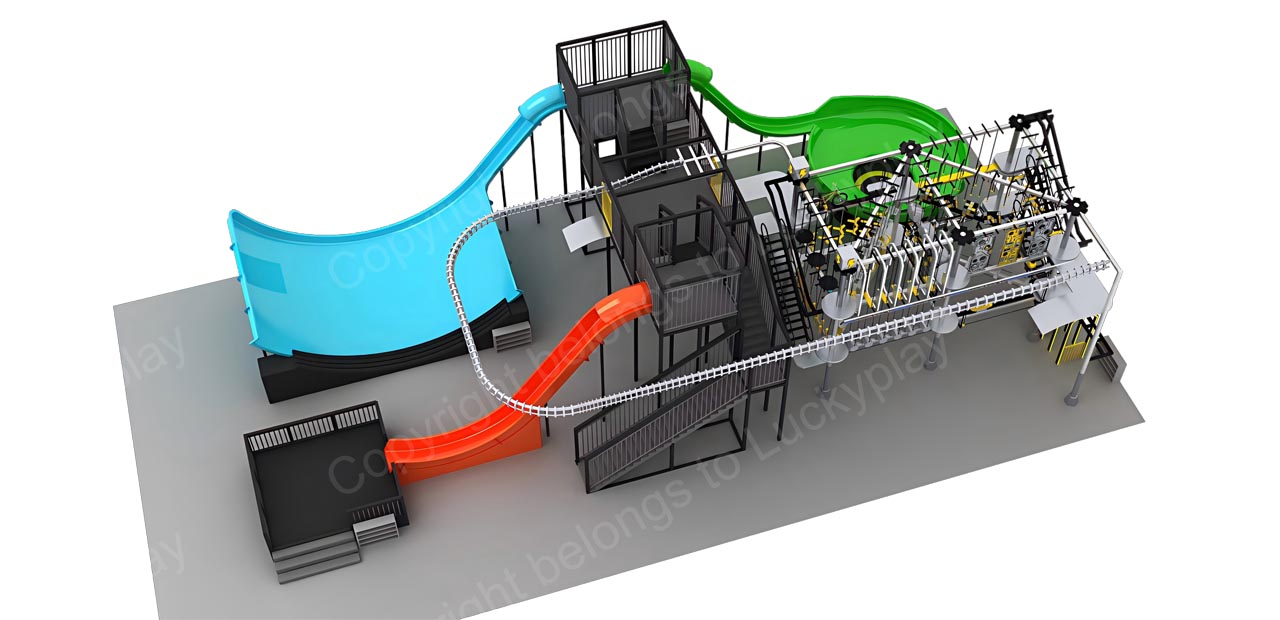
Some equipment earns attention through visual spectacle. The Matrix Slide 5.0 earned it through performance — and then became a spectacle because of it.
The Problem With Traditional Commercial Slides
Speed decay is one of the most underappreciated problems in commercial indoor playground operations. A slide that delivers a thrilling descent in the first month of operation begins losing that experience gradually — through surface wear, friction buildup, and structural micro-changes that accumulate invisibly. Within a year, many conventional slides are delivering a fraction of the experience they were installed to create. Visitors notice even if they can't articulate why. Return rates soften. The installation that once drew queues quietly becomes background furniture.
LUCKYPLAY's engineering team built Matrix Slide 5.0 to solve this specific failure mode. Its low-friction slide technology doesn't just make the initial descent faster — it maintains that performance under high-traffic commercial conditions. The result: sliding speed 1.8x smoother than comparable market-standard slides, with sustained performance integrity over time.
What 1.8x Smoother Actually Means for Your Business
At the booth, this translated immediately into theater. Children who completed the slide didn't walk away satisfied — they ran back to queue again. The visible replay behavior attracted observers, who then attracted more observers, creating the self-reinforcing crowd dynamic that every FEC operator dreams of engineering. Smartphones appeared within minutes. The slide became one of the most photographed products of the entire expo.
For investors, the commercial case is straightforward. High-traffic equipment that maintains its performance reduces the operational cost of "experience refresh" — the expensive, disruptive process of replacing or refurbishing underperforming installations. Matrix Slide 5.0 isn't just a slide; it's a long-term traffic asset that pays back its installation cost over a longer operational window than conventional alternatives.
2 — A Glimmering Secret Realm: Where Futuristic Design Meets Eastern Aesthetics
If Matrix Slide 5.0 won the Day 2 technical conversation, A Glimmering Secret Realm won something harder to quantify and arguably more valuable: the emotional conversation.
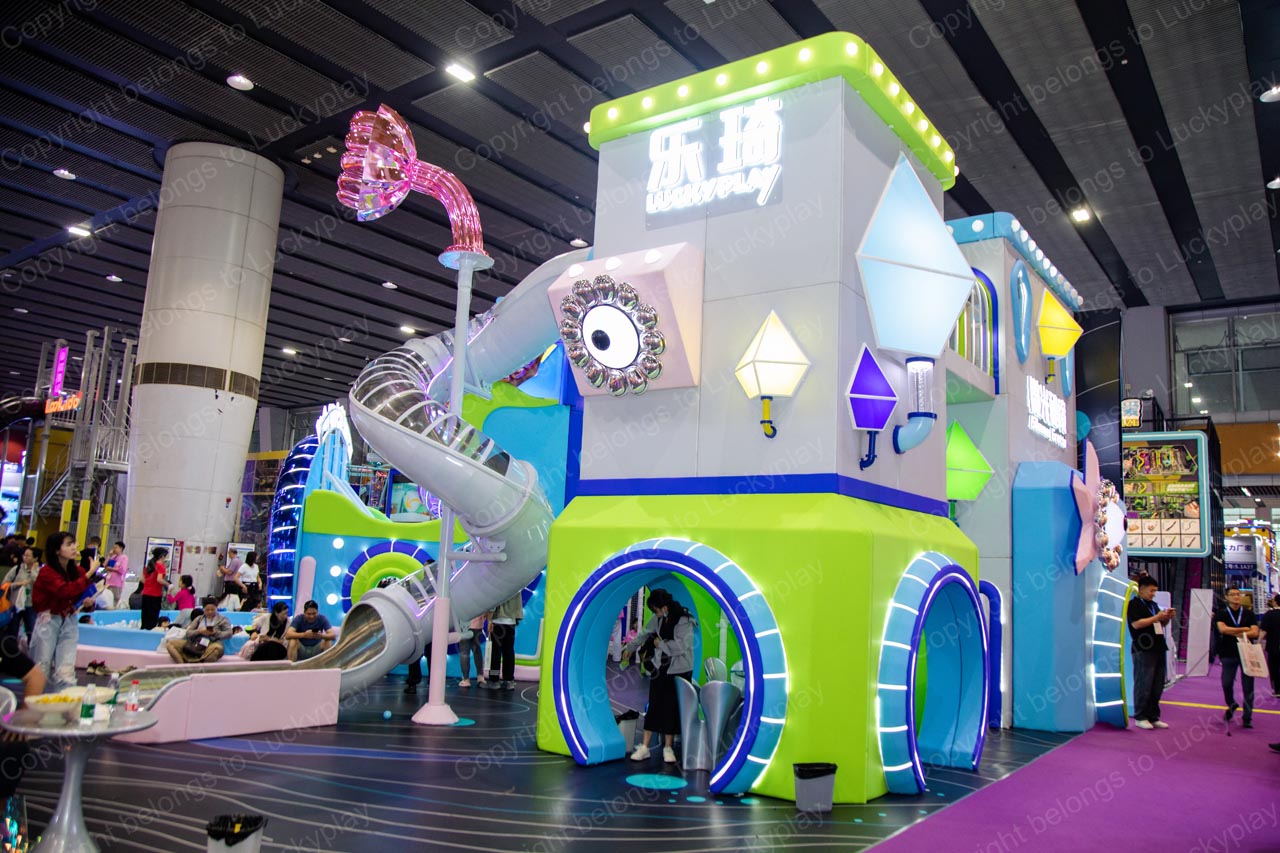
LUCKYPLAY positions this installation as a "futuristic oriental fantasy garden" — and that description does real conceptual work. It isn't marketing language. It's a precise articulation of a design philosophy that fuses two currents that are rapidly gaining traction in premium FEC development globally: the visual language of science fiction and technology, and the atmospheric depth of traditional Eastern aesthetics. The result is an environment that doesn't look like anything else on the exhibition floor — and, more importantly, won't look like anything else in the markets where LUCKYPLAY's clients are building.
Why Immersive Storytelling Is Replacing Generic Theming
The industry has spent fifteen years discovering that children engage more deeply — and parents pay more willingly — when a playground has a world rather than just equipment. Generic theming (jungle themes, space themes, ocean themes) provided a first-generation answer to this insight. But those concepts have been replicated so widely that they've lost their power to differentiate. Visitors recognize them instantly as a category, not as a destination.
A Glimmering Secret Realm operates at a different level of storytelling sophistication. The installation integrates sci-fi movement mechanics with glowing organic aesthetics — surfaces and structures that pulse and shimmer as if alive — creating the sensation of exploring a living ecosystem from another dimension. The fantasy narrative isn't applied as decoration; it's embedded in the structural logic of the space itself. Children don't just play in it. They inhabit it.
On Day 2, this installation became one of the primary crowd-gathering points of the entire LUCKYPLAY booth. Families who entered stayed significantly longer than they did at conventional playground equipment nearby. The immersive visual environment created an almost automatic dwell-time extension — the kind that translates directly into higher per-visit spend at adjacent F&B and retail.
Social Media Value as a Business KPI
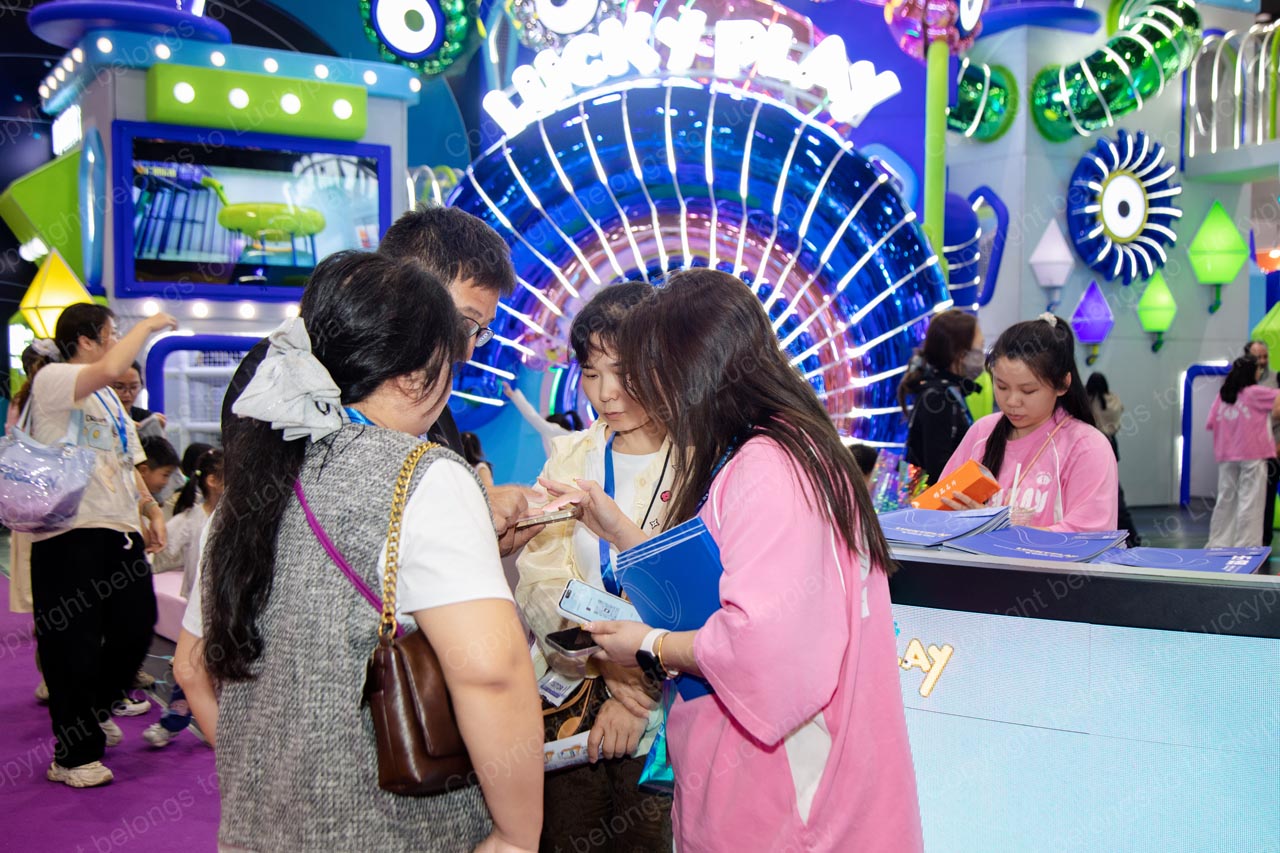
There was a secondary commercial metric visible in real time at the expo: phones. Visitors photographed and filmed A Glimmering Secret Realm at a rate that stood out even in an exhibition hall full of novel products. For FEC investors who understand content economics, this behavior has a precise dollar value. Every guest-generated post featuring a visually distinctive installation is an organic marketing impression. The most successful entertainment venues in the world — from immersive art museums to luxury escape rooms — have built significant portions of their traffic model on this dynamic. LUCKYPLAY has built it into the product's DNA.
3 — Weird Soundwave Playground: The Science of Dwell Time
The name is deliberate. In an industry where product naming tends toward the literal or the grandiose, Weird Soundwave Playground signals something different from the first moment you hear it: this installation was designed to surprise.
Why Sensory Play Drives Repeat Visits
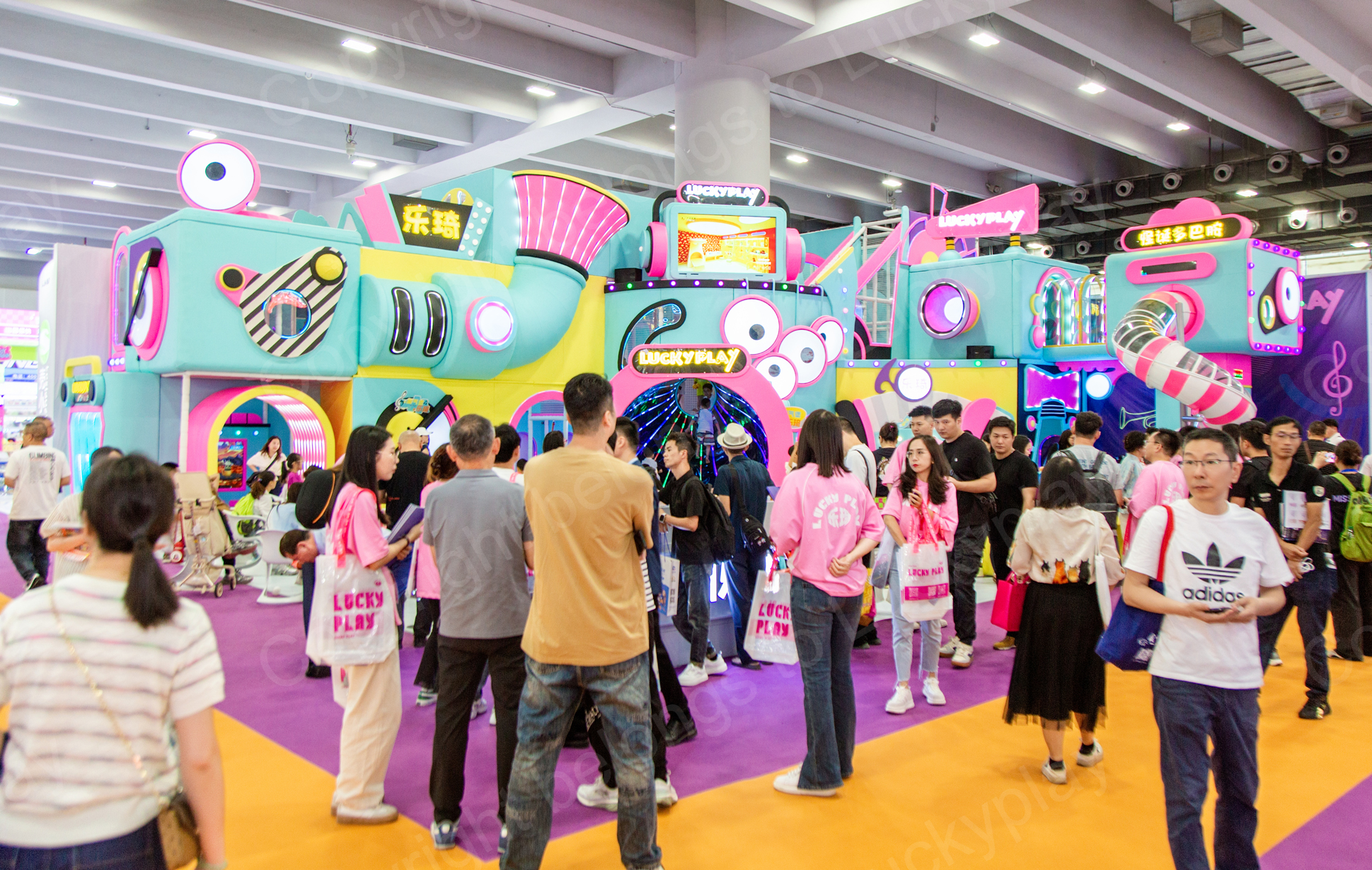
The concept integrates rhythmic interactive play with multi-sensory immersion — movement, music, tactile feedback, and sound all functioning together as a coherent play experience rather than independent features stacked in the same space. The effect on children is observable and measurable: they don't play through the installation once and move on. They cycle through it repeatedly, discovering new interaction patterns, responding to different sound configurations, drawing in peers who want to understand what they're experiencing.
This is the commercial core of the Weird Soundwave Playground — it generates replay behavior. In FEC economics, repeat play from the same guest during a single visit is the purest form of return on floor space. It means a child who might otherwise migrate to a different area of the venue remains engaged with a single installation, extending total dwell time for the entire family unit.
At the booth, the effect was visible within minutes of each demonstration. Children who had already played through the installation returned. Parents who had been watching began participating. The installation produced what operators call "stickiness" — the quality that keeps guests in a venue rather than moving toward the exit.
For investors developing FEC projects where operational staffing costs are a significant line item, the Weird Soundwave Playground offers an additional advantage: its interactive mechanics are largely self-guided. The play concept is intuitive enough that children direct their own experience without requiring staff facilitation, reducing operational overhead while maintaining engagement quality.
What Overseas Buyers and Investors Were Really Evaluating
The international buyer profile at LUCKYPLAY's Day 2 booth was notable. Groups from Southeast Asia, the Gulf region, and European markets spent extended time in conversations that moved well beyond product specification. What were they actually evaluating?
Traffic logic. Does this installation draw people to a specific area of the venue, and does it hold them there? Both A Glimmering Secret Realm and Weird Soundwave Playground demonstrated clear affirmative answers — live, in real time, on the expo floor.
Social transmission. Does this installation create content that guests want to share? In an era where organic social media reach is one of the most cost-effective acquisition channels available to FEC operators, this question carries direct revenue implications. The smartphone behavior visible around A Glimmering Secret Realm on Day 2 answered it.
Operational durability. Does this product maintain its performance and appeal over a multi-year operational window? Matrix Slide 5.0's engineering response to speed decay addressed this directly.
Differentiation. Can we build something around this that our market hasn't seen? This is the question that drove the factory tour bookings. Investors weren't just evaluating products — they were evaluating whether LUCKYPLAY could help them build something genuinely distinctive in their specific market.
Why Turnkey Playground Solutions Are Now a Competitive Necessity
The investment environment for FEC development has shifted meaningfully in the past three years. Capital is more selective. Feasibility requirements are stricter. Developers who once built entertainment venues on intuition are now expected to present detailed traffic models, experience differentiators, and operational cost projections before funding is released.
In this environment, the value of a true turnkey partner — one that delivers not just equipment but design strategy, project integration, installation management, and post-opening support — has increased dramatically. Investors don't want to coordinate between a design firm, a structural engineer, an equipment manufacturer, and an installation crew. They want a single point of accountability that understands the full commercial logic of what they're building.
How LUCKYPLAY Delivers End-to-End Project Capability
This is the positioning that LUCKYPLAY reinforced at every level of its Day 2 presence — not through sales language, but through demonstration. The booth itself functioned as a proof of concept: a curated, immersive environment that showed what LUCKYPLAY's design team builds, not just what they catalog. Every product on display was a LUCKYPLAY original — conceptualized, engineered, and manufactured in-house. Every conversation about customization was grounded in real project experience, not theoretical flexibility.
For investors who made the decision to book factory visits directly from the booth, that demonstration was the deciding factor. They weren't just buying equipment. They were engaging a partner capable of delivering a complete commercial entertainment environment — from initial concept through opening day.
That's a different kind of exhibitor. And it's why the LUCKYPLAY booth felt, on Day 2, less like a product showroom and more like the first conversation in a project partnership.
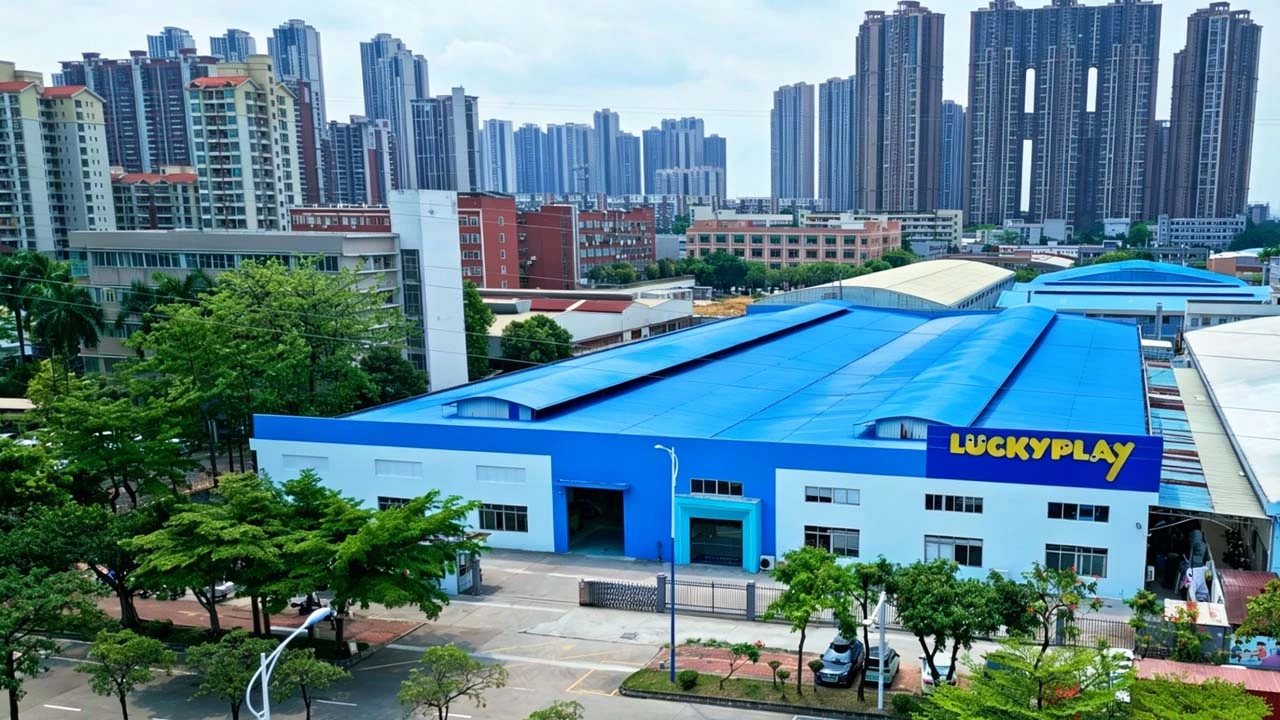
Ready to See What Your Next Project Could Look Like?
The products that generated the most attention at AAA Expo 2026 — Matrix Slide 5.0, A Glimmering Secret Realm, and Weird Soundwave Playground — are available for customized integration into new and existing FEC projects globally.
Whether you're developing a large-format entertainment destination, refreshing an existing indoor playground, or exploring a first investment in the commercial amusement space, LUCKYPLAY's team is ready to move from conversation to concept.


